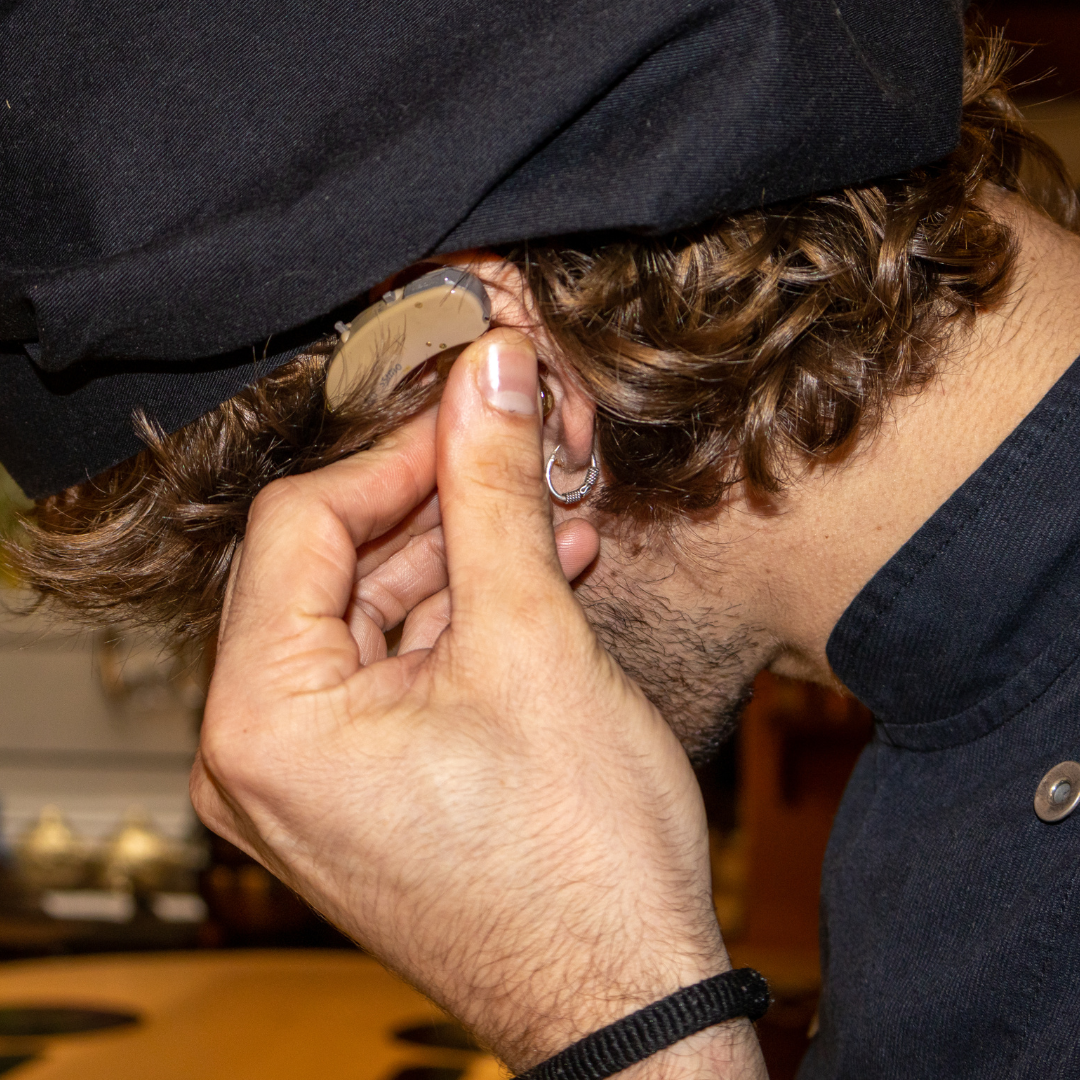
Group discussions in restaurants often become difficult to comprehend when room acoustics compete with your focus and hearing. Our practice provides targeted diagnostics to evaluate hearing in quiet atmospheres as well as complex noise environments. When we isolate the root mechanism behind your difficult hearing, we guide you toward customized communication solutions.
How Can Hearing Seem Normal at Home but Fail in a Restaurant?
In quiet conditions, an optimal signal-to-noise ratio ensures that the desired speaker sounds markedly clearer than surrounding sound. Restaurants create the opposite situation. Competing conversations, background music, tableware clatter, and acoustic reflections clash with incoming speech, making auditory processing exceptionally strenuous.
Such difficulty frequently signals sensorineural high-frequency hearing loss, auditory processing dysfunction, or noise-induced cochlear damage. Visual limitations from low lighting, cognitive fatigue, and sitting farther away from conversational partners amplify speech degradation. Some patients pass standard pure-tone evaluations with normal scores yet exhibit substantial impairment during specialized speech-in-noise testing. Experiencing speech-recognition struggles in noisy dining venues warrants a formal audiological evaluation regardless of seemingly normal quiet hearing.
How Audiologists Identify High-Frequency Hearing Loss
Our diagnostic process starts with a detailed case history reviewing problematic listening scenarios, occupational noise exposure, tinnitus, ototoxic medications, and familial genetics.
Pure-tone audiometric evaluations measure the absolute quietest sounds audible across specific octave frequencies using air and bone conduction. In high-frequency hearing loss, the audiogram reveals a sloping configuration where hearing acuity drops progressively as pitch frequencies increase. Further clinical diagnostics feature tympanometry to evaluate eardrum and middle-ear mechanics as well as word-recognition testing for speech comprehension.
Because a quiet booth does not recreate a busy dining room, speech-in-noise testing can add valuable information. It calculates your ability to identify verbal phrases as competing background noise levels rise. Together, these results show whether the problem involves audibility, speech clarity, background-noise processing, or a combination of factors.
Understanding Auditory Processing Disorders in Noisy Environments
An auditory processing disorder degrades the central nervous system’s capacity to organize and interpret complex sound inputs. The physical ear mechanisms may capture tones correctly, but the central brain pathways struggle to filter competing inputs, parse similar consonants, or interpret rapid speech. Our protocol begins by thoroughly testing peripheral hearing before determining if a specialized central auditory-processing battery or interdisciplinary referral is warranted.
Practical Strategies for Improving Speech Understanding in Noise
Simple situational adjustments enhance the speech signal entering your ears and offer clearer facial cues. Before leaving home, identify quieter dining venues or plan to eat during less crowded service times. Facilities equipped with upholstered booths, acoustic baffles, fabric curtains, carpeted floors, and soft materials prove far easier on hearing than minimalist, hard-tiled spaces.
In-venue communication guidelines:
- Request a table away from the kitchen, bar, speakers, and large groups.
- Sit with your back near a wall to reduce noise coming from behind you.
- Position yourself directly opposite your companions where direct lighting highlights their facial expressions.
- Keep conversational proximity as close as comfortably feasible to preserve acoustic signal strength.
- Place your better-hearing ear toward the person you most want to hear.
- Instruct conversational partners to reword missed phrases instead of repeating the entire sentence verbatim.
- Confirm important details rather than pretending to understand.
- Excuse yourself for a momentary quiet pause when listening exhaustion starts to mount.
- Encourage friends to enunciate clearly while maintaining an even, normal conversational tempo.
- Speaking with excessive volume creates acoustic distortion that fails to make words clearer.
What Are the Best Tools for Hearing with Background Noise?
Optimal technological solutions depend entirely on the etiology of your symptoms, target acoustic spaces, and whether measurable hearing loss exists. Professionally programmed hearing aids incorporate multi-channel directional microphones, digital noise reduction algorithms, and custom restaurant settings to capture frontal speech while attenuating background interference. They still require realistic expectations because no device can remove every unwanted voice.
Remote wireless microphones offer an exceptional boost to the signal-to-noise ratio in challenging venues. Worn on the speaker’s collar or set on the table, the microphone broadcasts direct audio to paired hearing aids or specialized receivers. This reduces the effects of distance and surrounding noise.
Further practical hearing technology options include:
- Dedicated table microphones engineered to capture small-group dialogue
- Telecoils or hearing-loop systems in equipped venues
- Smartphone speech-to-text or live-captioning applications
- Earbuds or hearables with compatible assistive-listening features
- Decibel-monitoring apps and crowd-sourced dining platforms that track restaurant noise
We can compare options, confirm compatibility, and teach you how to use the selected device.
How an Audiologist or Physician Can Improve Hearing in Noise
A hearing evaluation can move the conversation beyond “I hear fine in quiet.” Our clinicians review the specific environments, vocal pitches, and decibel levels that trigger breakdowns to design a personalized test protocol. Your comprehensive workup may involve pure-tone hearing thresholds, middle-ear testing, recorded word recognition, and speech-in-noise measures. Specialized auditory-processing testing can be ordered when patient history and preliminary audiometric findings warrant deeper neural investigation.
Sudden unilateral hearing drops, acute asymmetric changes, or rapid auditory decline mandate evaluation by an ear, nose, and throat physician. Individualized diagnostic care pinpoints the precise physiological etiology rather than merely blaming restaurant noise for communication struggles.
Book Your Comprehensive Hearing Evaluation Now
When dining out causes you to guess at words, detach from family, or experience severe listening exhaustion, book a comprehensive hearing evaluation with us. We will help you navigate hearing in noisy environments by implementing advanced hearing aid options, assistive accessories, or therapeutic auditory strategies tailored to your lifestyle.
Contact our audiology office today to schedule your evaluation and move toward effortless, confident conversations.